Relay
An AI on-call manager that handles the night, takes care of the tenant, and tells you in the morning who's about to move out.
Role
Sole product designer. Strategy, research, design, and prototype.
Impact
6 of 7 emergencies handled overnight (designed scenario, not production data)
Timeline & Tools
7 days, Lovable, Claude
One incident, 3 users: Tenant reports > Crew dispatches > Manager catches up in the AM.

“If a pipe bursts at 2 a.m., it’s my phone that rings. I’m the one calming down an angry tenant, getting somebody out there, and losing sleep too many days of the month. I feel like I can’t keep up, and the frustration is burning me out.”
The 2 a.m. problem
That's the whole problem from someone living it. Relay does two things about it, on two different clocks: it handles that call itself, the night it happens, and it watches how tenants are feeling across those calls over time, so Maya can catch someone about to move out before it's too late.

That night
Autonomous overnight triage
When something breaks at 2 a.m., Relay reads the situation, works out a plan, and acts across the real systems involved — no one wakes up Maya unless it's the one call that actually needs a person.
Walks the tenant through a shut-off in real time, and asks how they're doing
Dispatches the vendor, approves initial costs, and keeps everyone updated
Escalates only what's irreversible, costly, or outside the line the company set

The following weeks
Sentiment → renewal risk
Every incident leaves a trace of how the tenant felt. Relay reads that trail over time, lines it up against who actually renewed, and surfaces the tenants who are souring — early enough for Maya to still reach out.
Every flag traces back to a specific incident, not a black-box score
Feeds Outreach: one at-risk tenant at a time, message already drafted
Saves lease renewals that would otherwise have been lost
Outcome up front
6 of 7
overnight-triage incidents handled without waking the manager
Designed six-month scenario, not production data.
What one bad night costs
A bad night doesn't stay a maintenance ticket. It turns into a feeling, and the feeling is what costs money.

Manager churn
Maya takes the 2 a.m. calls until she's done, and then she's gone. Now you're hiring and training someone new.

Tenant churn
An angry tenant at renewal time is a vacancy you'll pay to fill.

Reputation
One bad review sits there for years, naming Maya personally, talking the next applicants out of signing.
All three start in the same place: a stretched-thin manager gives a slower, colder response, and the tenant feels it. One incident, handled badly, is enough to set all three in motion. Here's that same incident without the overnight triage you just saw:
That badly handled incident doesn't stay a maintenance ticket. It turns into a feeling, and the feeling is what costs money.
At its core, Relay communicates feelings.
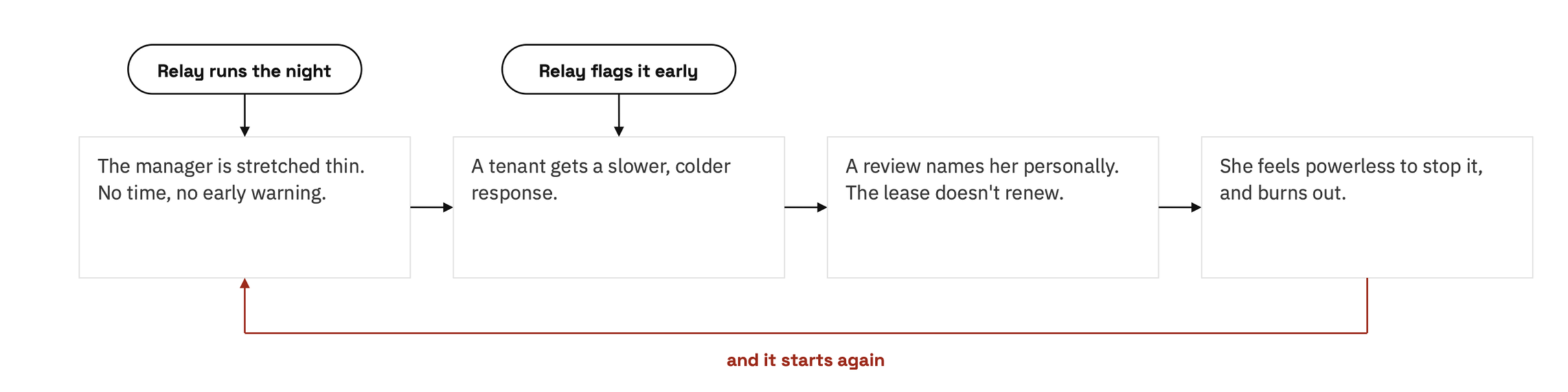
And it isn't a one-time cost, it's a loop. A stretched-thin manager gives a slower, colder response. The tenant sours and writes the review. She feels powerless to stop any of it, and burns out. Then it starts again with whoever replaces her.
And it isn't a one-time cost, it's a loop. A stretched-thin manager gives a slower, colder response. The tenant sours and writes the review. She feels powerless to stop any of it, and burns out. Then it starts again with whoever replaces her.
The manager stays, the tenant renews, and the reviews start getting better.
Watch it run
One incident, 3 users: Tenant reports > Crew dispatches > Manager catches up in the AM.
A 1:47 a.m. water leak: two crews decline, one accepts, the first quote clears inside budget at 12:10 a.m., and by morning the manager sees what was handled and the one thing that wasn't.
The decisions
What I decided, and what it cost.
The escalation line is company policy, not a personal setting. Managers can't set their own limits. I gave up that personal control so owners would trust the system enough to turn it on. It doubles as the adoption ramp: start with Relay only suggesting, widen the line as the track record builds.
Focus mode instead of a queue. One at-risk tenant at a time, at the point in the day when her attention is thinnest. Less at-a-glance breadth, far less cognitive load.
One source of truth for every number. Two screens once disagreed on the same figure. I made both derive from one field rather than patching the display, so they can never drift again.
Trust and control
It’s an Agent, not a dashboard.
Relay reads what happened, works out a plan, acts across the real systems involved, and at the one point that genuinely needs a person, it stops and hands the decision back.
Three things have to be true before any company turns an agent loose on a real building.
It stays inside the line. The company decides how far Relay can go on its own, and it never goes past that.
It only interrupts when it counts. Not a question about everything, not silence about everything. It hands back the specific decision that can't be undone, with the context already gathered.
Nothing it does is hidden. Every action is written down along with why, so trust gets earned instead of assumed.
When the AI is wrong
Designing for the failure cases.
It flags someone who was fine. The cost is asymmetric. A needless friendly call is cheap, a missed at-risk renewal is expensive. So Relay tunes toward catching more, ranks by severity so the surest cases come first, and lets the manager skip in two taps.
The tenant asked not to be texted. Then the primary action becomes a call and texting is disabled. Never contact someone the way they asked you not to.
Every vendor declines. Dispatch works down the list, and if it runs out, that escalates too, with the options attached rather than a dead end.
It can't tell how bad something is. A vague report gets one clarifying question, not a guess.
3 people are in every incident
Most property software designs for one of them. I designed for all three.
It flags someone who was fine. The cost is asymmetric. A needless friendly call is cheap, a missed at-risk renewal is expensive. So Relay tunes toward catching more, ranks by severity so the surest cases come first, and lets the manager skip in two taps.
The tenant asked not to be texted. Then the primary action becomes a call and texting is disabled. Never contact someone the way they asked you not to.
Every vendor declines. Dispatch works down the list, and if it runs out, that escalates too, with the options attached rather than a dead end.
It can't tell how bad something is. A vague report gets one clarifying question, not a guess.
The tenant. Support bots are cold and loop you until you give up. Relay's tenant side is what I call “AI Dad”: it talks a scared 22-year-old through the shut-off at 1 a.m., and asks how they're doing while it does. That question isn't decoration. Gen-Z renters will tell you exactly how they feel, and they'll do it publicly, so how you ask is also how the sentiment data gets collected. The reporting stepper is the instrument.